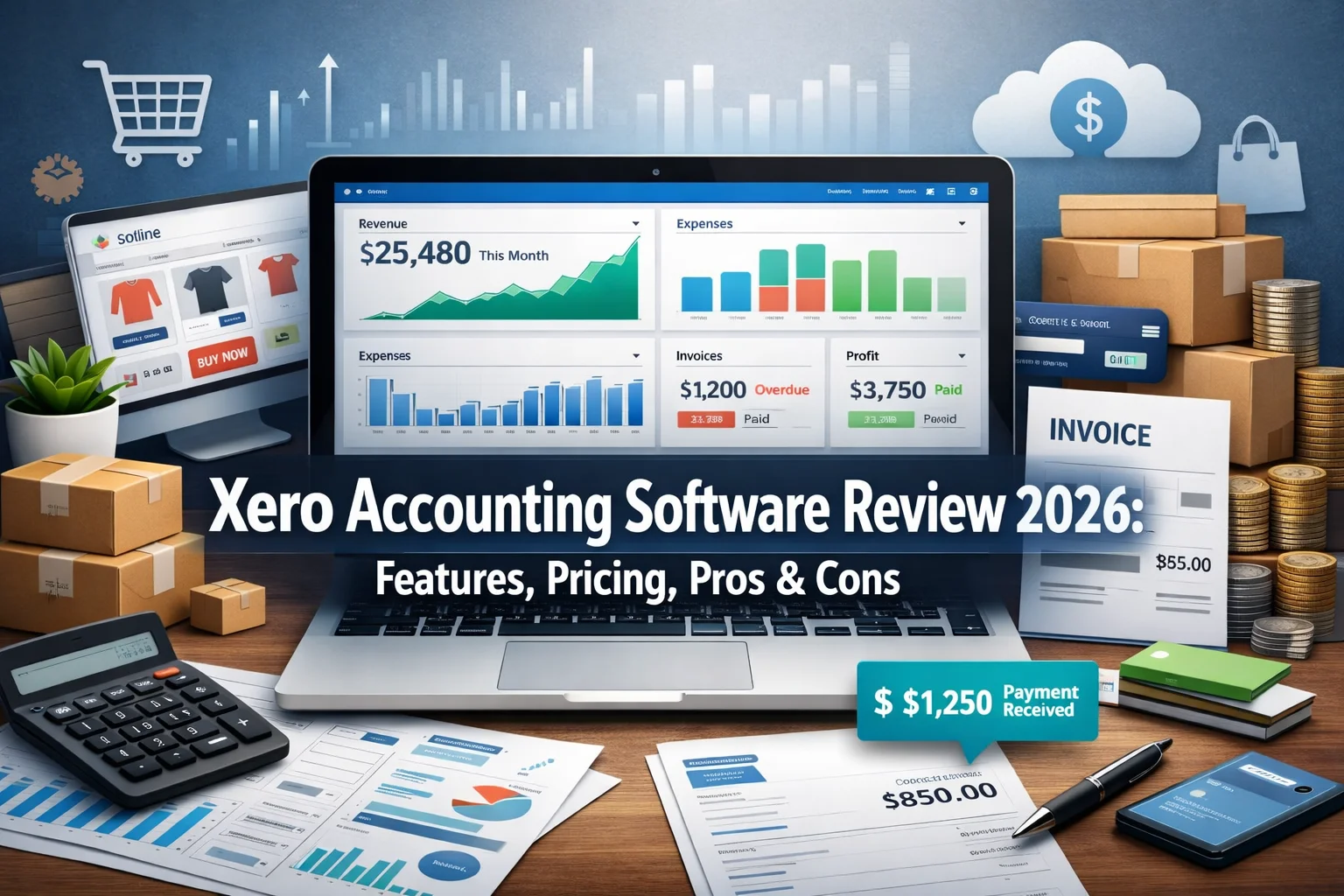
Xero Accounting Software Review 2026: Features, Pricing, Pros & Cons
In today’s digital business landscape, having reliable accounting software isn’t a luxury—it’s a necessity. Whether you’re a freelancer, small business owner, agency manager, or ecommerce entrepreneur, accurate bookkeeping and financial insights are fundamental to success.
One platform that has become a major player in cloud accounting is Xero. Launched in 2006, Xero has continually evolved, adding features and integrations that help small and mid‑sized businesses save time, reduce errors, and make better financial decisions.
In this detailed 2026 review, we’ll cover:
- What Xero is and who it’s best for
- Features & functionality
- Pricing and plans
- Integrations and app ecosystem
- Pros & cons
- Comparisons with competitors
- Real‑world use cases
- Final verdict
Let’s dive in.
What Is Xero?
Xero is a cloud‑based accounting software platform designed to automate bookkeeping and financial management tasks for small to medium businesses and accountants. Unlike traditional desktop accounting systems, Xero runs entirely online, allowing users to access their financial data from anywhere via web browser or mobile app.
As of 2026, Xero supports millions of businesses globally and continues to be one of the most widely adopted cloud accounting solutions for companies looking to streamline financial operations.
It’s particularly strong in:
- Automated bank reconciliation
- Invoicing and payments
- Expense tracking
- Financial reporting
- Multi‑currency accounting
- App integrations
Who Is Xero Best For?
Xero’s flexible design makes it suitable for multiple business types. It’s especially useful for:
1. Small Businesses
Companies without dedicated accounting departments benefit from Xero’s automation and ease of use.
2. Freelancers and Consultants
Simplifies invoicing, tracks payments, and provides profit visibility.
3. Agencies and Creative Firms
Xero handles project expenses, billable hours (with integrations), and partner access.
4. Ecommerce Businesses
Connects with platforms like Shopify, WooCommerce, and payment gateways for automated sales syncing.
5. International Companies
Multi‑currency support and global tax settings benefit businesses with overseas clients.
However, enterprises with highly complex accounting (e.g., advanced inventory costing, consolidated multi‑entity reporting) may need a more advanced ERP solution.
Xero Features (2026 Breakdown)
Here’s an in‑depth look at the most valuable features Xero offers in 2026.
1. Dashboard & Financial Overview
The Xero dashboard gives a real‑time snapshot of your business financial health, including:
- Bank balances
- Aged receivables and payables
- Cash flow indicators
- Profit & loss trends
- Outstanding invoices
This high‑level view helps business owners make quick decisions without generating separate reports.
2. Automated Bank Feeds & Reconciliation
One of Xero’s headline features is automatic bank feeds—your transactions are imported daily from your bank accounts.
Xero’s reconciliation engine suggests matches between imported transactions and existing records (invoices, bills, expenses). This drastically reduces manual data entry and reconciliation errors.
3. Invoicing and Payments
With Xero, you can:
- Create and send professional invoices
- Set up recurring invoices
- Attach payment links (Stripe, PayPal, Square)
- Track when invoices are viewed or paid
- Set automatic payment reminders
Online invoice payments help speed up your cash flow by allowing customers to pay directly through the invoice.
4. Expense Management
Xero’s expense features include:
- Receipt capture via mobile app or Hubdoc integration
- Expense categorization
- Billable expenses assigned to clients
- Employee expense claims
Hubdoc captures bills, receipts, and documents automatically and syncs them with Xero, reducing manual receipt entry.
5. Multi‑Currency Accounting
Multi‑currency support is built into higher‑tier plans and allows you to:
- Send invoices in client’s currency
- Track exchange rate movements
- Convert and report financials across multiple currencies
This is invaluable for businesses dealing with international clients or suppliers.
6. Financial Reporting & Analytics
Xero offers robust reporting including:
| Report Type | Purpose |
|---|---|
| Profit & Loss | Shows revenue, expenses, and net income |
| Balance Sheet | Summarizes assets, liabilities, and owner equity |
| Cash Flow Statement | Tracks cash movement |
| Aged Receivables | Displays outstanding customer invoices |
| Aged Payables | Lists unpaid supplier bills |
| Budget vs Actual | Compares financial performance |
Reports are customizable and exportable to PDF or Excel, making them useful for stakeholders and accountants.
7. Inventory Management
For product‑based businesses, Xero’s inventory system tracks:
- Product quantities
- Sales and purchase costs
- Real‑time stock valuation
While not as advanced as full inventory systems like QuickBooks Commerce, it provides essential insights for most small businesses.
8. Payroll Integration
Xero offers payroll functionality in select regions, including:
- Employee setup and pay schedules
- Automatic tax calculations
- Leave management
- Pay runs and payslips
Payroll integration ensures compliance and simplifies employee payment processes.
9. Projects & Time Tracking (via Integrations)
While Xero’s core product has basic project tracking, advanced time and project profitability management is better served through integrations like:
- Harvest
- Toggl
- WorkflowMax
These integrations sync billable hours and project expenses to invoices.
10. Mobile App
Xero’s mobile app includes:
- Snapshot of financial performance
- Bank reconciliation
- Receipt capture
- Invoice creation and tracking
- Dashboard view
This allows business owners to manage finances on the go.
Xero Pricing (2026)
Xero pricing varies by region and plan. Below is a general current pricing structure for 2026 (approximate and subject to change):
| Plan | Approx. Monthly Cost | Key Features |
|---|---|---|
| Starter | $20 – $30 | Basic invoicing, transaction reconciliation, limited bills/invoices |
| Standard | $40 – $50 | Unlimited invoices/bills, bank reconciliation, financial reporting |
| Premium | $60 – $80 | Multi‑currency, advanced analytics, payroll (region dependent) |
Notes:
- Pricing may vary based on promos or regional tax.
- Free trials are often available for new users.
Xero App Integrations
Xero integrates with over 1,000+ third‑party apps to help automate business workflows:
| Category | Examples |
|---|---|
| Ecommerce | Shopify, WooCommerce |
| Payments | Stripe, PayPal, Square |
| CRM | HubSpot, Salesforce |
| Payroll | Gusto, KeyPay |
| Time Tracking | Harvest, Toggl |
| Document Capture | Hubdoc, Receipt Bank |
| Inventory | Unleashed, TradeGecko |
This extensive ecosystem makes Xero adaptable for many business types.
Pros & Cons of Xero
Here’s an honest look at Xero’s strengths and limitations.
Pros
✔ Cloud‑based – Access financials anywhere
✔ Unlimited users – No additional cost for team access
✔ Powerful automation – Bank feeds, reconciliation, reminders
✔ Strong reporting – Customizable financial insights
✔ Multi‑currency support – Ideal for global business
✔ Large app ecosystem – Integrations for every workflow
Cons
✖ Time tracking limitations – Needs add‑ons for advanced project billing
✖ Learning curve for beginners – Especially for complex features
✖ Payroll availability depends on region – Not globally available
✖ Inventory features are basic compared to dedicated systems
Xero vs Competitors (Quick Comparison)
Many businesses compare Xero with alternatives like QuickBooks Online and FreshBooks.
Xero vs QuickBooks Online
| Feature | Xero | QuickBooks Online |
|---|---|---|
| Ease of Use | Moderate | Beginner‑friendly |
| Invoicing | Strong | Strong |
| Reporting | Advanced | Advanced |
| Bank Reconciliation | Excellent | Excellent |
| Time Tracking | Add‑ons | Built‑in |
| Multi‑Currency | Yes | Yes |
| Users | Unlimited | Plan dependent |
Summary: QuickBooks Online is arguably easier for absolute beginners, while Xero offers better scalability and unlimited users.
Xero vs FreshBooks
| Feature | Xero | FreshBooks |
|---|---|---|
| Invoicing | Strong | Very Strong |
| Expense Tracking | Excellent | Good |
| Time Tracking | Add‑ons | Built‑in |
| Reporting | Advanced | Basic |
| Multi‑Currency | Yes | Limited |
Summary: FreshBooks is great for freelancers focused on simple invoicing and time tracking, while Xero is more comprehensive for business accounting.
Real‑World User Insights
Small Business Owners Say:
✔ “Automated bank feeds save hours weekly.”
✔ “Unlimited users make collaboration with my accountant easy.”
✔ “The financial reporting gives my team clear visibility into cash flow.”
Areas Some Users Want Improved:
❌ “Project time tracking is not robust without add‑ons.”
❌ “Initial setup takes time if migrating from another system.”
Tips for Getting the Most Out of Xero
- Enable Bank Rules
Create bank rules to automate categorization. - Use Hubdoc for Documents
Attach receipts and bills automatically. - Review Reports Monthly
Regularly run Profit & Loss and Cash Flow reports to monitor health. - Train Your Team
Get users familiar with features like reconciliation and invoicing. - Explore Integrations
Connect your CRM, ecommerce, and payment tools for seamless data flow.
FAQ’s
1. Is Xero suitable for small businesses?
Yes. Xero is designed to help small and medium businesses automate accounting and improve financial clarity.
2. Can Xero handle payroll?
Yes, but payroll availability depends on your region.
3. Does Xero offer a free trial?
Yes, new users can often start with a free trial.
4. What devices can Xero be used on?
Xero is cloud‑based and works on web browsers, as well as iOS and Android mobile apps.
5. Does Xero support accountants?
Yes. Xero allows unlimited users, making it easy to collaborate with accountants and advisors.
Final Verdict
Xero remains one of the most powerful, flexible, and scalable accounting solutions for small to medium businesses in 2026. Its automation, reporting capabilities, and app ecosystem make it ideal for companies that want to streamline financial workflows and gain real‑time insights without the complexity of enterprise‑level systems.
While some advanced features like time tracking or deep project accounting may require integrations, the core accounting functionality—bank reconciliation, invoicing, reporting, multi‑currency, and unlimited users—makes Xero a standout choice.
Whether you’re a freelancer managing clients, an ecommerce store owner balancing inventory and sales, or a small business looking to grow, Xero delivers a reliable and modern accounting platform that saves time and reduces financial stress